Aligned, multiple-transient events in the First Palomar Sky Survey
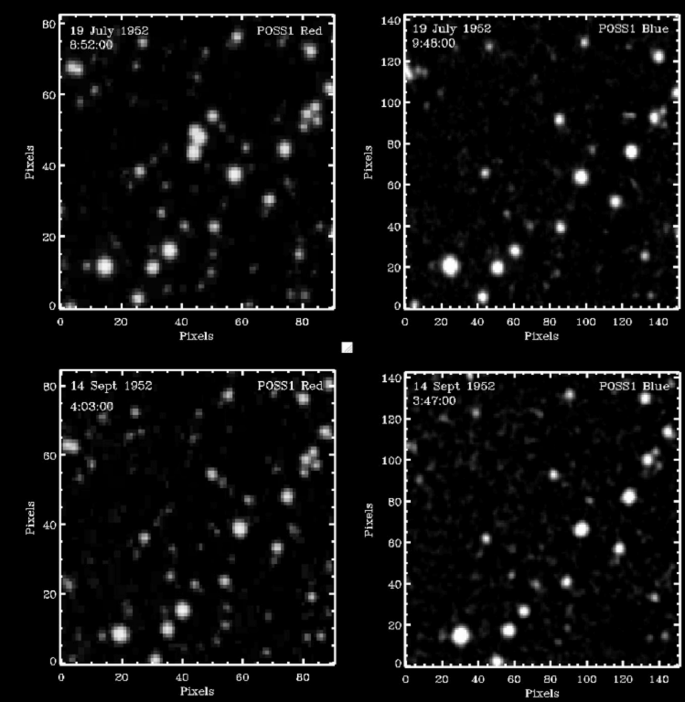
Four POSS I images showing a transient that appeared in a red-band exposure on July 19, 1952 (upper left) but vanished within 10 minutes and never returned.
Bottom Line: Researchers analyzing 1950s astronomical photographs—taken before any satellites existed—found unusual patterns of aligned flashing lights and a striking shortage of these flashes in Earth's shadow. The patterns are statistically significant but can't definitively rule out camera artifacts.
Key Facts:
- Dataset: Palomar Observatory sky photos from 1949-1957, before Sputnik
- Method: Searched for multiple bright spots aligned in straight lines within single photographs
- Primary Finding: Several candidate alignments with strong but not conclusive statistical patterns
- Shadow Pattern: Highly significant shortage of flashes appearing in Earth's shadow at satellite orbit height
- Historical Correlations: Flashes 45% more likely near dates of nuclear weapons tests; also correlated with UFO report dates from that era
- Image Quality: The flash images look sharper and rounder than normal stars, suggesting very brief bursts of light (less than one second) rather than camera defects
Possible Explanations:
- Reflections from unknown objects in space (but predates known satellites)
- Rare camera lens artifacts that create fake bright spots
- Flaws in the photographic film itself (though image analysis suggests otherwise)
- Unknown atmospheric or space phenomena
Why It Matters: These historical photos provide a unique "before" snapshot of the sky before the satellite era. Whether these flashes are camera problems, unknown natural phenomena, or something else, the patterns are real puzzles worth investigating. The Earth shadow pattern is particularly difficult to explain as a random artifact.
Sources:


